
Event information
From urban action to corporate practice, use actions to fight for a breath and give the next generation a blue sky
Are blue skies and clean air just a luxury for Taiwanese people? In fact, from urban actions to corporate practice, many people are working hard to combat air pollution. Let’s see how local governments and companies use innovation to save you and me.
In recent years, air pollution has become a global focus. In particular, the cover story of Issue 667 of "Tianxia Magazine" "Fake Data, Vacuum Pollution: Who Will Give Taiwan a Fake Blue Sky?" After its publication, it attracted great attention from the government, civil society and enterprises, and everyone hopes to take positive actions to improve air pollution.
According to the recommendations of the World Health Organization (WHO), the safety standard value of PM2.5 is an annual average concentration of 10 micrograms. Cai Hongde, deputy director of the Environmental Protection Agency of the Executive Yuan, said that Taiwan's average has dropped from 22.5 micrograms two years ago to 17.5 micrograms last year, and will continue to work towards the target of 15 micrograms this year.
"We need everyone to work together to fight for it!" Lu Guochen, deputy chief editor of Tianxia Magazine, revealed the monitoring data of 326 listed chimneys in Taiwan. He was happy to see changes, including the introduction of smart control software at the Chiahui Power Plant in Chiayi to reduce fuel use and nitrogen oxide emissions. Formosa Plastics Group, a named pollution source whose emissions have repeatedly exceeded standards, also proposed improvement measures on its own.
More and more people are investing in making Taiwan's sky brighter, and local governments are also proposing policy solutions tailored to local conditions from the perspective of urban development.
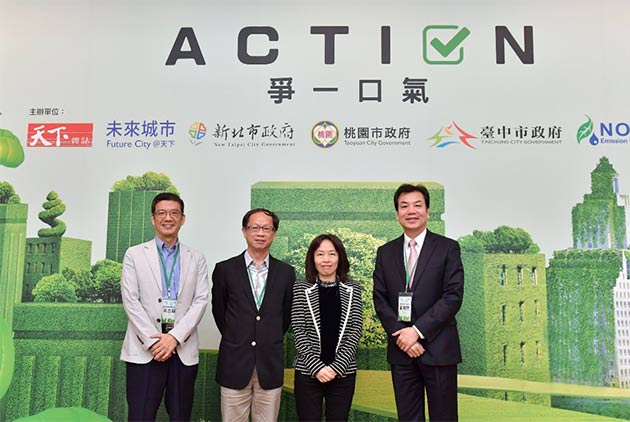
Under the Dome, Local Government’s Clearance Action Countermeasures
After years of hard work, the annual average air quality PM2.5 in New Taipei City has dropped to 15.4 micrograms last year. Although the numbers are impressive, Director Liu Heran of the New Taipei City Environmental Protection Bureau believes that "air quality cannot convince the public with numbers. It must be experienced by everyone in their lives." Therefore, for mobile New Taipei City has adopted seven major measures to deal with pollution sources, stationary pollution sources and fugitive pollution sources, including the suspension of coal-generating permits, the removal of all coal-fired boilers, the replacement of highly polluting vehicles, the promotion of electric buses, discounts on parking and charging of electric vehicles, the ban of high-polluting construction machinery and strict management of residential and restaurant fumes, etc., which is a multi-pronged approach.
Taoyuan City, which has experienced continuous growth in population, transportation and industrial output in recent years, is also facing the challenge of increasing environmental load. But can we only choose between economic development and air quality? Director Lu Lide of the Taoyuan City Environmental Protection Bureau pointed out that there are too many details to improve air pollution. From industry, transportation to people's daily lives, Taoyuan City's economic activities continue to be booming, but the number of days with good air quality has also continued to grow, and the results are obvious. He said: "Local governments are not only supervisors and managers, but also important liaisons, because in the fight against air pollution, the government, enterprises and the people must be on the same front."
As Taiwanese voters become less and less tolerant of air pollution, Taichung City, which produces the most oil in Taiwan, has certainly attracted attention from all walks of life. Wu Zhichao, director of the Taichung City Environmental Protection Bureau, emphasized that air pollution emission reduction should be changed from public agencies and large pollution sources, "Public before private, first big before small, so that the people will feel it." Therefore, in addition to calling on many parties to decommission the old units of Taichung Thermal Power Plant, the Taichung City Government has also actively introduced various innovative technologies to ban monitoring and invest in the development of green transportation. At the same time, it supports the development of the green energy industry through regulations and subsidies, hoping to achieve a balance between air pollution control, industrial economy and citizens' lives, creating a win-win situation.
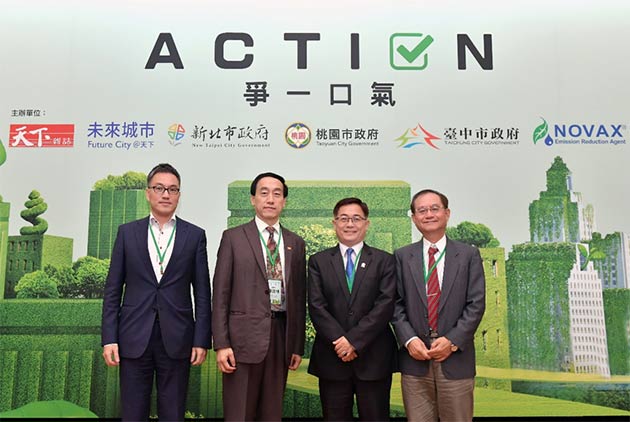
Best Practice! Enterprise innovation solutions strive for a breath of fresh air
Actions against air pollution continue to spread. While seeing the government actively formulating regulations, setting standards, and strengthening inspections, how can companies respond with actions? Associate Professor Lu Zhaohui from the Department of Mechanical Engineering at National Chung Hsing University pointed out, "We can see that more and more companies are willing to invest in research and development to provide new solutions for reducing emissions and carbon emissions with innovative technologies."
.jpg)
Nova Materials Technology, which has green environmental protection as its mission, invested in the company 13 years ago and is now the largest supplier of automotive catalysts and reducing agents in the Asia-Pacific region. It not only provides the most important environmentally friendly fuel for diesel commercial vehicles, but has also recently taken the initiative to build smart systems at gas stations across Taiwan to create more convenience for car owners. Chairman Yang Lianzhi said that although Taiwan's regulations are in sync with international standards, they are relatively backward in technology for reducing stationary pollution sources. In the future, Nova will continue to expand the Taiwan market, provide more innovative technologies and more popular services, and work together to provide a breath of fresh air for the next generation.
As environmental regulations become increasingly stringent, Chen Xiaolin, Vice President of BASF Environmental Catalysis Asia Pacific R&D Center with more than 25 years of R&D experience in the field of environmental catalysis, pointed out that "technological innovation can not only meet the needs of society, but also create economic benefits." He has long been invested in the design and development of new technologies for reducing harmful gas emissions, focusing on engine exhaust gas after-treatment systems. Based on the current mature technology, he hopes to further develop waste reduction technologies with more competitive cost-effectiveness and optimized efficiency in the future to reduce mobile pollution sources.
As the world's largest automobile group, Audi is the third largest imported car in Taiwan. With the wave of electric vehicles coming, Audi has not only launched pure electric vehicles to seize the market, but is also actively building a green supply chain around the world. Chen Baijun, Marketing Director of Audi Taiwan, said, "In the future, the group expects to launch a quarter of pure electric vehicles in 2025. By 2050, we will achieve carbon neutrality goals for all the group's brand products and comprehensively reduce carbon emissions from product manufacturing processes." Actions demonstrate the determination to pursue environmental protection and seek innovative solutions.
Combating air pollution requires collective efforts. Whether it is the government, enterprises, or even individuals, if we continue to do so, we can eventually give our next generation a blue sky.